

Plan a fishing trip: read the forecast from departure to return
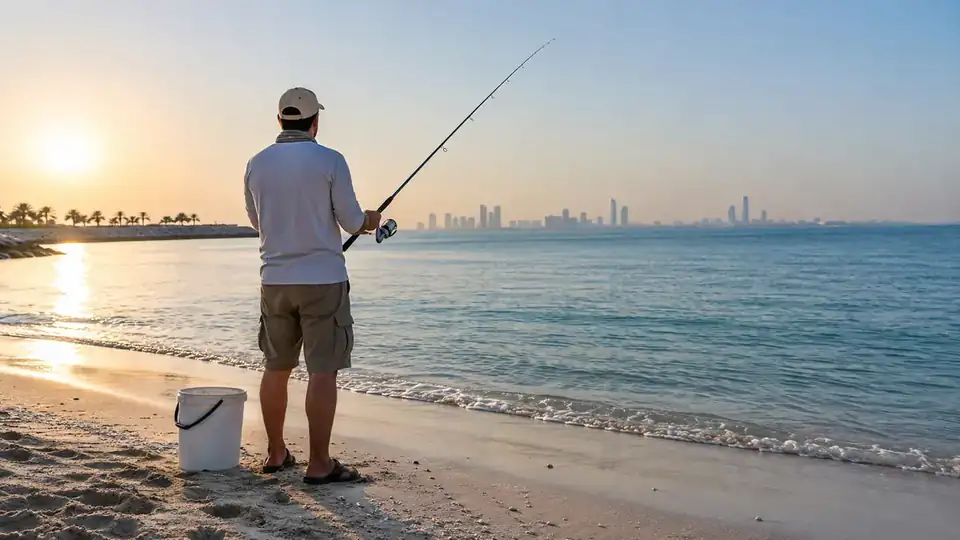
Before choosing the highest-rated day, decide what you want to do, how much time you have and who is joining. A short casting lesson and a distant boat trip require different plans.
Turn the forecast into a sequence: place and time, the whole trip interval, matched preparation and observations for the next visit.
1. Match place, time and units
Compare the same coordinates, local date and forecast hours. Al Khiran and Fnaitees are not interchangeable. A reference tide station does not measure conditions inside every creek. Record whether the product is a forecast or an observation and when it was updated.
Check knots versus km/h for wind, metres for waves and seconds for period. Tide heights also need the same vertical reference before direct numerical comparison.
2. Review departure, fishing and return
Read all three parts of the trip. A daily summary can hide a short period of stronger gusts or a change after arrival. Put missing hours down as unavailable rather than zero.
An astronomical calendar can calculate future moon events without having a detailed weather forecast for that date. Keep those capabilities separate when interpreting a distant day.
3. Water level and current are different
Tides describe changing water level; currents describe horizontal water movement. A water-level change in metres per hour is not a current velocity in metres per second. A high-tide time alone does not establish flow speed in a particular channel.
For shore fishing, changing level may affect the standing area and exit. Current can change line angle and presentation. Record both observations without using one vague label for every kind of movement.
4. Ask what a score means
A high value might reflect season, wind or a lunar window. Ask which inputs are missing as well. Fishing suitability is not a percentage chance of catching a fish or a vessel safety percentage.
Two algorithms can disagree because their definitions and weights differ. Test measurable inputs first, then assess how useful the advice is across documented trips. Do not tune a score merely to resemble a competitor.
5. Make a specific alternative plan
Define a return time and review cancellation or shortening decisions with the skipper. For shore fishing, know the exit as water levels change. For boat fishing, discuss loading, fuel, communications, equipment and applicable local requirements with the person responsible for the vessel.
Only after the trip itself is suitable should you choose the target and presentation. A few matched tackle options are more useful for a beginner than a large bag of unexplained alternatives.
6. Keep the unsuccessful trips too
Record the general place, approximate time, method, bait, forecast, observed conditions and outcome. Include blank trips and postponements so that the record is not biased toward successful days.
Avoid creating a rule from one outing. Change one factor at a time where practical and compare repeated experiences. This gradually builds local knowledge that helps you use any forecast more intelligently.
Make the alternative specific
Decide in advance what happens if access fails, weather changes or tackle becomes unmanageable. Discuss the plan with companions or the skipper. Afterwards, record what changed and why. A shorter session or a timely postponement can be a well-executed decision.
Continue learning
- Wave height and period: why a small fishing boat can feel uncomfortable
- Waves and wind on shore: choosing a position and reading tackle movement
Sources and further reading
- www.weather.gov — safeboating-marine
- oceanservice.noaa.gov — tidescurrents.html
- www.met.gov.kw — www.met.gov.kw
Educational guidance, not a vessel-motion calculation or a navigation forecast. Review the official local marine bulletin.
Choose the next lesson
This guide has a specific job. Use the related lessons for a different decision rather than reading the same subject as one general forecast.