

Waves and wind from shore: choose your position before casting harder
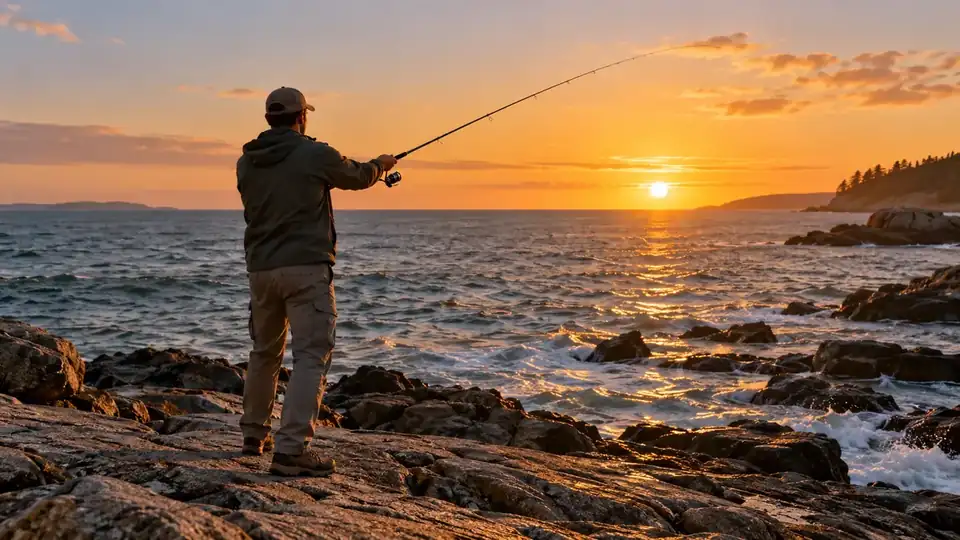
Light local wind can accompany incoming wave sets, and a straight cast can still leave the line drifting sideways. Observe wind, waves and tackle movement separately.
Choose suitable footing first, then a presentation you can control instead of treating greater casting force as the solution.
1. Observe several sets from dry ground
Watch the furthest reach of the water across several wave groups. One quiet minute does not establish a dry working area. Check whether rising water could cover a low section of the return route, and choose your standing position before choosing casting distance.
Another angler's presence is not evidence that the place suits your experience or equipment. Avoid stepping down onto wet ledges just to improve a cast.
2. Separate wave direction from wind direction
A coast facing east is directly exposed to waves coming from the east in a simplified reading. Local depth, protection and seabed shape still matter. One city contains differently oriented beaches, structures and headlands.
Wind and waves can come from different directions. Do not copy the wind arrow into the wave field. Refraction near shallows and headlands means a regional arrow is not a detailed map between individual rocks.
3. Offshore wind does not remove incoming swell
A breeze from land can help casting and reduce local surface chop near shore. It does not prove that incoming swell is absent or that exposed water is comfortable. Watch what the line and bait actually do.
Do not chase floating equipment carried offshore. Replacing tackle or changing the setup is preferable to entering water to recover it.
4. Diagnose tackle movement before adding weight
Does the sinker shift with each group and then hold, or drift continuously along the shore? Does the bait return tangled around the leader? Those observations help separate holding problems from rig problems.
Change one variable at a time: casting position, distance or a setup appropriate to the bottom. If the necessary sinker would exceed the rod's rating, choose matched equipment, another permitted location or another time. No fixed fraction of a sandbar is a universal casting rule.
5. Moving water is not a guarantee of feeding
Water movement may redistribute sand and food, but species and places respond differently. More waves do not mean progressively better fishing. Any theoretical advantage loses value when footing or tackle control becomes difficult.
Record whether bait returns untouched, disappears or receives short bites. Adjust size and presentation systematically rather than changing every variable together.
6. Apply the idea locally
A sheltered Gulf creek and an exposed nearby headland can feel very different even within one model grid cell. On an open Mediterranean coast, incoming sets can arrive with little local wind. Compare the forecast with observations from a suitable position and review the whole return route.
After the session, write down wind and wave direction separately, sinker behaviour and the water's furthest reach. Those notes make future decisions more specific than simply calling the sea good or bad.
When the sinker keeps moving
Determine whether it shifts with each set and then holds, or drifts continuously. Try a manageable distance or angle change and inspect for tangles. Check tackle ratings before increasing weight; a different place or time may solve the problem better.
Continue learning
- Wave height and period: why a small fishing boat can feel uncomfortable
- Read the marine forecast: a fishing plan from departure to return
Sources and further reading
Educational guidance, not a vessel-motion calculation or a navigation forecast. Review the official local marine bulletin.
Choose the next lesson
This guide has a specific job. Use the related lessons for a different decision rather than reading the same subject as one general forecast.